EngClub.in is a beginner-friendly English learning platform focused on spoken English, simple grammar tips, daily English sentences, FAQs, Courses and speaking practice.
Translate
Regular and Irregular Verbs : Rules & Verbs list
Get link
Facebook
X
Pinterest
Email
Other Apps
By
Dev S
– TEFL-certified Tutor
– Last Updated: June 01, 2025
"Verb" is the word which shows an action in a Sentence. In English
there are two types of verbs "regular and irregular".
Let's talk about regular and irregular verbs. Don't worry, it's not as
complicated as it sounds!
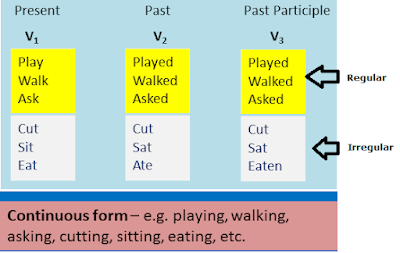
Regular verbs follow a pattern when we change their tenses. For
example, "walk" becomes "walked" in the past tense, and "walking" in the
present participle form. Easy, right?
Now, irregular verbs are a bit trickier. They don't follow the same
pattern as regular verbs. Instead, they change in unique ways when we move
between tenses. For instance, "go" changes to "went" in the past tense,
which is different from just adding "-ed" like regular verbs.
Understanding regular and irregular verbs is super important for speaking
and writing correctly in English. Are you ready? So let's start.
In these verbs we add “ed” at the end of Base form (V1) for formation of
Past simple (V2) and Past Participle (V3).
For example:
Base Form (V1)
Past Simple (V2)
Past Participle (V3)
Open
Opened
Opened
Want
Wanted
Wanted
Earn
Earned
Earned
A. Rule 1:
If the verb ends with "e" simply add "d".
For example:
Base Form (V1)
Past Simple (V2)
Past Participle (V3)
Live
Lived
Lived
Like
Liked
Liked
Dance
Danced
Danced
Hate
Hated
Hated
B. Rule 2:
If the verb ends with "Vowel + y" simply add "ed").
For example:
Base Form (V1)
Past Simple (V2)
Past Participle (V3)
Play
Played
Played
Stay
Stayed
Stayed
Enjoy
Enjoyed
Enjoyed
C. Rule 3:
If the verb ends with "Consonant + y" change "y to i" and add "ed" .
For example:
Base Form (V1)
Past Simple (V2)
Past Participle (V3)
Cry
Cried
Cried
Try
Tried
Tried
Fry
Fried
Fried
D. Rule 4:
If the verb has one syllable, single vowel and ending in single
consonant double the final consonant and add “ed”
For example:
Base Form (V1)
Past Simple (V2)
Past Participle (V3)
Rip
Ripped
Ripped
Nod
Nodded
Nodded
Stop
Stopped
Stopped
E. Rule 5:
If the verb has two syllables, stress on second syllable and ending in
single consonant double the final consonant and add “ed”
For example:
Base Form (V1)
Past Simple (V2)
Past Participle (V3)
Prefer
Preferred
Preferred
Commit
Committed
Committed
Submit
Submitted
Submitted
2. Irregular Verbs :
These Verbs form past simple and past participle in different ways.
These are formed mainly in four different patterns. The main change is
in vowels "a,e,i,o,u".
For example:
Sr.No.
Pattern
Base Form (V1)
Past Simple (V2)
Past Participle (V3)
1
All are Same
Read
Read
Read
2
V2 & V3 are Same
Think
Thought
Thought
3
V2 is different than V1 and V3
Run
Ran
Run
4
V2 & V3 are Different
Know
Knew
Known
Remember, Some verbs can be both regular and irregular.
Demonstrative Pronouns: What They Are and How They Work? These words (This, That, These, Those) are called demonstrative pronouns , and we use them to point to people or things.Learning when to use this, that, these, and those can be tricky for beginners in English. But don’t worry — this simple guide will make it easy! In this lesson, you’ll learn the difference between this and that, how to use these and those correctly, and see lots of easy examples for everyday English. Whether you're speaking or writing, mastering these four words will instantly improve your English. 📘 Table of Contents 1. What Are Demonstrative Pronouns? 2. How to Use Demonstrative Pronouns? 3. How Demonstrative Pronouns Work? 4. Other Uses of This, That, These, and Those in English 5. Demonstrative Pronouns (This, That, These, Those) Worksheet 6. This/That/These/Those FAQs Definition: A demonstrative pronoun is a type of pronoun that is used to point to specific...
100 Easy English Sentences Every Teacher Needs for Effective Communication Introduction If you're a teacher looking for simple sentences for the classroom, we've got the perfect collection of easy English sentences for teachers. Hello teachers! Are you looking for easy and friendly ways to communicate with your students in the classroom? You’re in the right place! Here are 100 Easy English sentences for teachers that you can use every day. These sentences are perfect for making classroom interactions smooth and enjoyable. These classroom English for beginners phrases will help you engage with kids in the classroom effectively. Enhance your English conversation in school and make learning English in the classroom fun and interactive. Use these classroom management sentences to maintain order while providing valuable English practice in school. These fun English sentences for students are ideal for teaching English in the classroom and making lessons enjoyable and productive. ...
Discover Simple English Sentences to Use at Train Stations! Are you ready to speak English confidently at a railway station? Whether you're traveling or helping someone else, these easy sentences will make your journey smoother. Perfect for beginners, this guide will help you communicate effortlessly in everyday situations. Are you ready to master English at train stations? With these 100+ Simple English Sentences to Use at Train Stations: Perfect for Beginners, you'll learn how to communicate confidently while traveling. From Essential Train Station English: 100 Simple Phrases for Travelers to practical tips, this guide covers everything you need. Whether it’s Common Questions at the Ticket Counter: Must-Know Sentences or learning how to navigate with these 100 Practical English Sentences to Use at Railway Stations, you'll gain the skills to handle any situation. Travel smart and speak like a pro with these Beginner-Friendly English Sentences for Train Stations!